


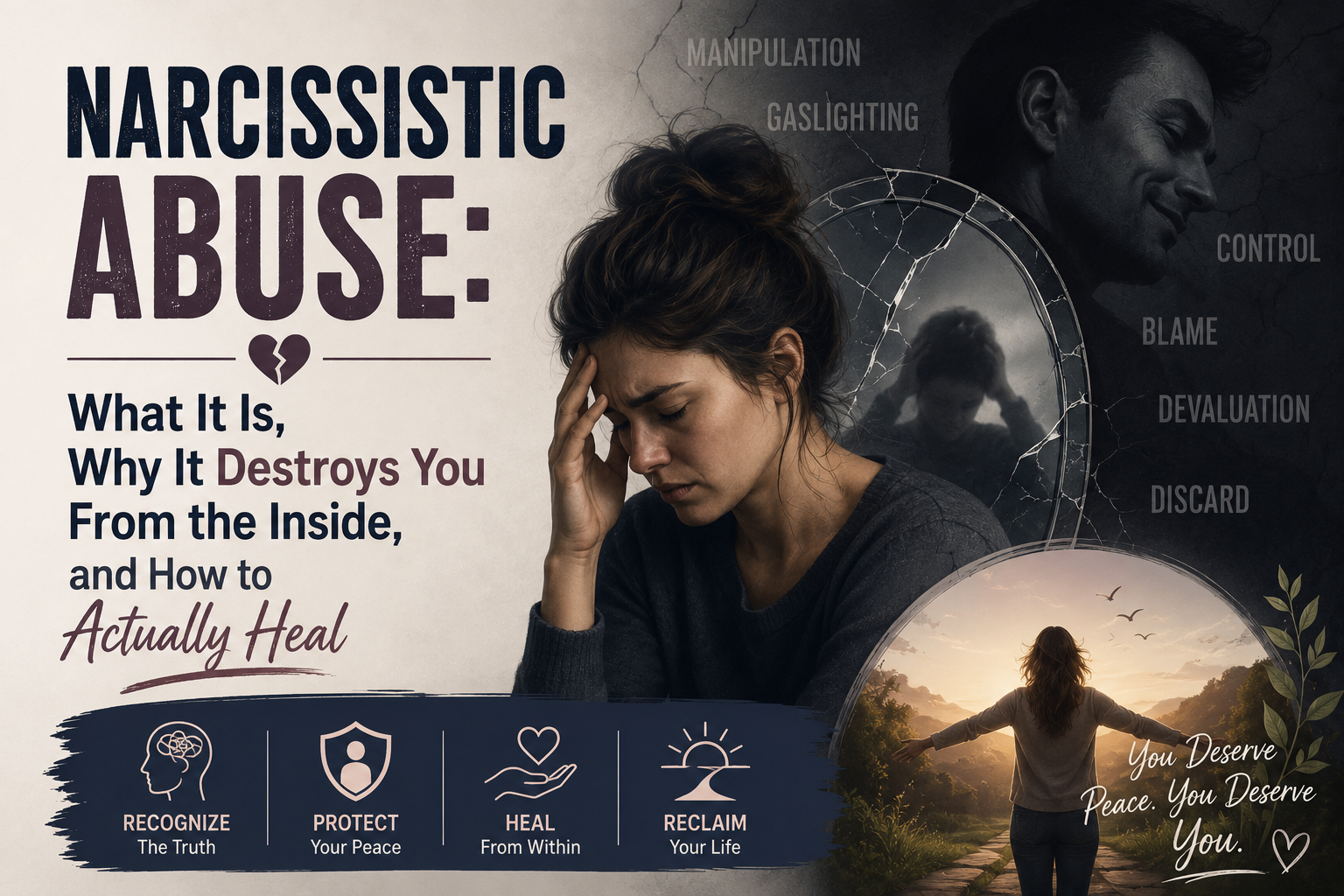
There is a very specific kind of confusion that comes from being in a relationship with a narcissist. It is not the straightforward pain of being with someone who is simply unkind. It is something more disorienting than that. It is the feeling that you are slowly losing your grip on reality. That you are constantly walking on eggshells but are not entirely sure why. That the person who made you feel more loved than you had ever felt in your life is now making you feel like the most worthless person in the room, and somehow you have ended up apologising for it.
If that sounds familiar, this is for you.
Narcissistic abuse is one of the most misunderstood and underdiagnosed forms of psychological harm. It does not leave visible marks. It rarely involves screaming or physical violence. What it does instead is systematically dismantle your sense of self, one interaction at a time, until you are no longer sure what is real, what you deserve, or who you even are anymore.
Understanding what happened to you is the first step out of it. So let us start there.
What Narcissistic Personality Disorder Actually Is
Narcissism exists on a spectrum. Every human being has some narcissistic traits. Self-confidence, a sense of personal worth, the desire to be admired, and these are healthy and normal. The problem begins when these traits become so extreme, so rigid, and so pervasive that they cause genuine harm to the people around the person who holds them.
Narcissistic Personality Disorder, or NPD, is a formal clinical diagnosis defined in the DSM-5 (the Diagnostic and Statistical Manual of Mental Disorders) as a pervasive pattern of grandiosity, an intense need for admiration, and a profound lack of empathy that persists across contexts and over time. A person with NPD is not just occasionally self-centred. Their entire psychological architecture is built around the management of a deeply fragile self-image, one they spend enormous energy protecting and inflating at the expense of the people closest to them.
According to the National Epidemiologic Survey on Alcohol and Related Conditions, the lifetime prevalence of NPD in the United States is approximately 6.2 percent of the population, with 7.7 percent of men and 4.8 percent of women meeting diagnostic criteria. That is not a rare condition. That is tens of millions of people. And around every person with NPD is a circle of partners, children, parents, and colleagues who are experiencing the impact of it, often without any framework for understanding what is happening to them.
It is important to note that NPD is not a character flaw that someone chose.
Research consistently points to a combination of genetic predisposition and environmental factors, particularly early childhood experiences involving emotional unavailability, excessive criticism, or paradoxically, extreme overvaluation by caregivers.
A 2024 review in NCBI specifically examined the link between childhood overgratification and narcissistic trait development. What this means is that people with NPD are often deeply wounded themselves. Understanding that does not mean you have to stay. It just means the picture is more complicated than pure villainy.
The Two Faces of Narcissism: Why You May Not Have Recognised It
Most people picture a narcissist as loud, arrogant, obviously self-important. The person who dominates every conversation, name-drops constantly, and walks into a room expecting applause. That is one type. It is called grandiose narcissism, or overt narcissism.
But there is another kind that is far less discussed and far more confusing to live with.
Researchers at Cambridge and in the field of clinical psychology have clearly established two distinct subtypes of pathological narcissism.
Grandiose (Overt) Narcissism presents exactly as most people imagine. Arrogance, entitlement, dominance, a constant need to be the most important person in any room. These individuals openly seek admiration and react with contempt or rage when they do not receive it. They are often charismatic and initially very compelling. Their manipulation is bold and unapologetic.
Vulnerable (Covert) Narcissism is the type that trips people up. Covert narcissists appear outwardly sensitive, quiet, sometimes even self-deprecating. They may come across as misunderstood victims of a cruel world. Their need for admiration is just as extreme as their grandiose counterpart, but they seek it through a different route: through appearing to suffer, through playing the martyr, through subtle emotional manipulation that keeps people around them in a constant state of guilt and obligation. According to BJPsych Advances, covert narcissists present as overly sensitive, insecure, and defensive, with an underlying sense of shame and inadequacy driving their behaviour.
The reason this matters for you: if the person who has hurt you was not obviously arrogant, if they seemed fragile and hurt and in need of your protection, that does not mean what you experienced was not narcissistic abuse. Covert narcissism causes equal damage. Often more, because the manipulation is harder to name and the person experiencing it is more likely to blame themselves.
The Cycle of Narcissistic Abuse
Narcissistic relationships follow a recognisable pattern. Not every relationship follows it identically, and not every person with narcissistic traits follows it deliberately. But once you understand the cycle, the chaos of what you experienced begins to make a terrible kind of sense.
Phase One: Love Bombing
It starts with overwhelming intensity. Attention, affection, and admiration that feels intoxicating. They pursue you with a focus that feels flattering at first, sometimes almost magical. They say things nobody has ever said to you. They make plans for the future after two weeks. They tell you that you are different from anyone they have ever met. That you understand them in a way nobody else does.
This phase is called love bombing, and it is not accidental. Whether conscious or not, it serves a specific psychological function: it creates a powerful emotional attachment before you know enough about this person to make a considered choice about them.
The neuroscience helps explain why this works so effectively. When you are being love bombed, your brain releases a powerful combination of dopamine, oxytocin, and serotonin. Dopamine drives desire and anticipation. Oxytocin creates the feeling of profound connection and trust. Serotonin regulates mood and emotional wellbeing. This cocktail creates feelings of euphoria and deep attachment. It is, in quite literal neurochemical terms, like falling under the influence of a powerful drug. And this matters enormously for what comes next.
Phase Two: Devaluation
At some point, without warning and often without explanation, things shift. The warmth becomes unpredictable. The praise is replaced by subtle criticism. The person who made you feel exceptional now makes you feel like nothing you do is ever quite right.
In June 2025, Klein, Wood, and Bartz published a significant theoretical framework in Personality and Social Psychology Review that offered the first rigorous cognitive-science account of how gaslighting works during this phase. Their finding: gaslighting operates through prediction error minimisation, the same neural mechanism the brain uses to learn from unexpected information. When someone you trust repeatedly contradicts your perception of reality, your brain starts to correct itself, just as it would with any other learning signal. You stop trusting your own experience. Not because you are weak, but because your brain is doing exactly what it has evolved to do when faced with confusing information from a trusted source.
Devaluation can involve any or all of the following:
Gaslighting: Denying that things happened, insisting you are remembering events incorrectly, making you feel that your emotional responses are irrational or crazy. “You’re too sensitive.” “That never happened.” “You’re imagining things.”
Criticism and contempt: Subtle put-downs, often disguised as jokes. Comparisons to others. Pointing out your flaws with the veneer of helpfulness. Eyerolling, sighing, dismissing your opinions in front of others.
Silent treatment and stonewalling: Withdrawing completely as punishment. Days of emotional unavailability as a response to any perceived slight.
Projection: Accusing you of exactly what they are doing. Calling you selfish when they are the one who never considers your needs. Accusing you of lying when they are the ones being dishonest.
Intermittent reinforcement: The most psychologically powerful mechanism of all. Random and unpredictable returns of the warmth from Phase One, just often enough to keep you trying, just infrequent enough to keep you perpetually anxious. Research in behavioural psychology has long established that intermittent reinforcement, reward given unpredictably rather than consistently, creates stronger behavioural conditioning than consistent reward. It is the same mechanism that makes gambling so addictive. And it is what keeps people in narcissistic relationships long after any rational analysis would say they should leave.
Phase Three: Discard
Eventually, many narcissistic relationships end in what survivors describe as the discard. The narcissist withdraws emotionally, moves on, and can appear to do so with shocking speed and apparent indifference to the person they had professed to love deeply. Sometimes there is a new partner almost immediately, often someone who is now receiving the love bombing that was previously directed at you.
This phase is devastating. Not just because of the loss, but because the cognitive dissonance is unbearable. How do you reconcile the person who told you they had never loved anyone like this with the person who has now moved on as if you were never there?
The Hoover
Narcissistic relationships do not always end cleanly. Many involve what clinicians call hoovering, attempts by the narcissist to pull you back in after you leave or after they discard you. This can look like an apparent return to the love bombing phase: apologies, declarations of change, reminders of the best moments you shared. It can also look like threats, accusations, or attempts to manipulate through your children, mutual friends, or family.
Understanding hoovering as a pattern rather than evidence of genuine change is critical to recovery.
Trauma Bonding: Why You Could Not Just Leave
One of the most painful misunderstandings that survivors of narcissistic abuse face is the question they receive from people who were not there: why did you not just leave?
The answer is trauma bonding. And it is not a weakness. It is a neurobiological process.
Research published in the International Journal of Research and Review in 2025, examining narcissistic abuse and domestic violence, explained trauma bonding in stark terms: victims may feel safest with the person who is most dangerous, due to a learned association between love and pain that mirrors early attachment experiences. The bond is reinforced by the same cycles of abuse and affection that create the strongest forms of neurological conditioning.
When the person who hurts you is also, intermittently, the person who makes you feel most loved, your nervous system cannot resolve the contradiction cleanly. What it does instead is attach to the hope of the good version, the version you first fell in love with, while attributing the bad version to something temporary, something you can fix, something that is maybe your fault. This is not foolishness. It is your brain trying to protect the attachment it formed during love bombing, an attachment that was forged with neurochemical intensity specifically to be hard to break.
A 2025 study published in Frontiers in Psychology, examining love addiction and the perceived acceptability of gaslighting, found that people with higher love addiction tendencies were significantly more likely to tolerate gaslighting in romantic relationships, with sense of giving and relationship power imbalances as key mediating factors. The research makes clear that vulnerability to trauma bonding is not about low intelligence or poor character. It is about attachment patterns, relationship power dynamics, and the way certain relationship histories make particular kinds of manipulation more effective.
What Narcissistic Abuse Does to Your Mental Health
Narcissistic abuse is not just emotionally painful. It causes clinically recognisable psychological harm, and that harm deserves to be taken seriously.
C-PTSD (Complex Post-Traumatic Stress Disorder) is one of the most commonly reported outcomes in survivors of long-term narcissistic abuse. Unlike PTSD which typically follows a single traumatic event, C-PTSD develops from prolonged, repeated exposure to psychological harm within a relationship where the person feels trapped. Symptoms include emotional dysregulation, persistent shame and self-blame, difficulty trusting others, hypervigilance, dissociation, and a pervasive sense of being damaged or worthless. Research including work published in preprint form in 2024 by multiple clinical researchers specifically examining narcissistic abuse categorises it as a significant and underrecognised cause of C-PTSD.
Anxiety disorders are extremely common in survivors. The hypervigilance of living with an unpredictable, reactive person does not simply switch off when you leave the relationship. Your nervous system has been trained to scan constantly for threat, for mood shifts, for signs of danger. That alarm system stays activated long after the source of danger is gone.
Depression frequently follows narcissistic abuse, particularly in the aftermath of the discard phase. The combination of loss, grief, shame, damaged self-worth, and the exhaustion of trying to make sense of what happened creates a perfect environment for depression to take hold.
Difficulty trusting your own perception. This is perhaps the most insidious long-term effect of chronic gaslighting. Many survivors describe a persistent inability to trust their own judgement, their own memory, their own emotional responses. They second-guess themselves in new relationships, at work, with friends. They were trained, systematically and over time, to believe that their perception of reality was unreliable. Undoing that takes time and genuine therapeutic work.
Narcissistic Abuse Across Relationships: It Is Not Just Romantic Partners
Most content on narcissistic abuse focuses on romantic relationships. But narcissistic abuse happens in every type of close relationship, and recognising it in non-romantic contexts is equally important.
The Narcissistic Parent
Growing up with a narcissistic parent is a particular kind of complex wound. A 2025 systematic review published in Cureus, authored by Orovou et al. from the University of Western Macedonia and collaborating institutions, synthesised research from 2015 to 2024 on the impact of parental NPD on parent-child relationships.
Their findings were clear: parental narcissism is associated with poorer relational and psychological outcomes in children, with antagonistic facets of grandiose narcissism consistently linked to colder and more controlling parenting.
If you grew up with a narcissistic parent, some of what you experienced may include: feeling like your sole purpose was to reflect well on your parent, never feeling good enough no matter what you achieved, having your emotions dismissed or ridiculed, being used as a confidant for adult problems that were not your responsibility, being loved conditionally based on how well you met your parent’s needs, and experiencing your sibling being treated drastically differently from you. This is called the golden child and scapegoat dynamic, and it is one of the hallmarks of narcissistic family systems.
The wounds from narcissistic parenting typically do not announce themselves clearly in adulthood. They show up as patterns: chronic people-pleasing, difficulty setting boundaries, an anxious need for external validation, a tendency to be drawn to emotionally unavailable or critical partners because that pattern feels familiar.
If you are a teenager or young adult reading this and something in the description of the narcissistic parent resonates with what you have experienced at home: what you are going through is real. It is not normal even if it feels normal because it is all you have known. And the confusion and hurt you feel is a completely understandable response to an environment that was never safe enough for you to simply be yourself.
The Narcissistic Boss or Colleague
Narcissistic abuse in the workplace is vastly underreported. A boss who takes credit for your work, publicly humiliates you to maintain dominance, creates a culture of favourites and outsiders, and makes you feel that your job security depends entirely on managing their ego, is engaging in narcissistic behaviour that can cause genuine psychological harm. The same tactics apply: intermittent reinforcement, gaslighting, criticism framed as concern, and exploitation of your dedication and competence.
The Narcissistic Friend
Friendships with narcissistic individuals tend to be profoundly one-directional. Everything revolves around their life, their problems, their achievements. If you are going through something difficult, the conversation will find its way back to them. Their empathy is performed when an audience is present and absent when it is just the two of you. Attempts to raise any concern about the friendship are met with injured victimhood that leaves you apologising.
How to Recognise If You Are in a Narcissistic Relationship Right Now
You may be reading this article because something feels wrong but you cannot quite name it. These are some of the most consistent signs that you are in a relationship with someone who has significant narcissistic traits:
- You find yourself constantly apologising without being entirely sure what you did wrong.
- Your achievements feel like they need to be minimised around this person to avoid conflict.
- You have stopped talking to friends or family as much as you used to, either because the person discourages it or because you are ashamed of how the relationship looks from the outside.
- You feel like you are always one wrong move away from their anger or withdrawal.
- You have noticed that your self-confidence has steadily decreased since the relationship began.
- When you try to raise a concern, the conversation always ends with your feelings being the problem rather than the behaviour you raised.
- You find yourself defending them to people who have expressed concern.
No single one of these is definitive. But if reading that list produced a feeling of uncomfortable recognition, pay attention to that feeling. It knows something.
Recovery: What It Actually Looks Like
Recovery from narcissistic abuse is real, and it is possible. But it is also genuinely hard, and it takes longer than most people expect. Here is an honest account of what the process involves.
Step One: No Contact or Low Contact
The research and clinical consensus on this is consistent: meaningful recovery from narcissistic abuse requires removing yourself from ongoing exposure to the narcissist’s influence. This is called going no contact, meaning severing all communication, or low contact, meaning the absolute minimum required contact (typically relevant when children are involved or when you share a workplace).
The reason no contact is necessary is not punitive. It is neurological. Your nervous system cannot begin to heal while it is still being intermittently reinforced and destabilised. Every contact, even contact that seems neutral or civil, can reactivate trauma bonding responses. The cycle needs to stop before healing can begin.
Expect the period immediately following no contact to be very difficult. The withdrawal from a trauma bond is genuinely similar to withdrawal from a substance. Your brain has been conditioned to seek the intermittent reward of the good moments. When those are removed, distress, grief, and an intense urge to re-establish contact are all normal. This does not mean you made the wrong decision. It means the bond was real and breaking it hurts.
Step Two: Understanding What Happened
One of the most important parts of recovery is constructing a clear, accurate understanding of what actually occurred in the relationship. This is harder than it sounds. Years of gaslighting have likely left your account of events full of self-doubt and gaps. Journalling helps. Therapy helps. Talking to trusted friends who witnessed the relationship helps.
The goal is not to build a case against the narcissist. It is to rebuild your ability to trust your own perception. When you can look at what happened and clearly say: “That was real. What I experienced was real. My reactions were reasonable given what was actually happening,” something very important begins to shift.
Step Three: Addressing Trauma With Professional Support
C-PTSD, anxiety, and depression that emerge from narcissistic abuse respond well to specific therapeutic approaches. EMDR (Eye Movement Desensitisation and Reprocessing) has strong evidence for treating the traumatic memory processing disruptions that are common in abuse survivors. Trauma-focused CBT helps restructure the distorted self-beliefs that narcissistic abuse instills. Somatic therapy addresses the physical manifestation of trauma that lives in the body even when the mind has processed the events intellectually.
It is worth specifically seeking a therapist with experience in narcissistic abuse and C-PTSD. Not all therapists have this experience, and a therapist without it may accidentally reinforce unhelpful narratives, such as encouraging you to “see both sides” of what was fundamentally an abusive dynamic.
<iframe width=”560″ height=”315″ src=”https://www.youtube.com/embed/tfBEKnU-ezk?si=YAyJSU_WZx7eCL8_” title=”YouTube video player” frameborder=”0″ allow=”accelerometer; autoplay; clipboard-write; encrypted-media; gyroscope; picture-in-picture; web-share” referrerpolicy=”strict-origin-when-cross-origin” allowfullscreen></iframe>
Step Four: Rebuilding Your Sense of Self
Narcissistic abuse is fundamentally an attack on identity. Recovery involves not just healing the wounds but rebuilding what was dismantled. This means gradually reconnecting with your own preferences, values, and opinions. It means noticing when you seek external validation and learning to provide yourself with the basic sense of worthiness that the relationship eroded. It means allowing yourself to have needs and not apologising for them.
This process is slow. Be patient with it. People who have spent years in a relationship where their needs were minimised or weaponised do not simply flip a switch and become self-assured. But every small act of self-trust is a step in the right direction.
Step Five: Attachment Patterns and Future Relationships
One of the most important parts of long-term recovery, and the one most often skipped, is understanding why you were vulnerable to this relationship in the first place. This is not about self-blame. It is about awareness.
Many survivors of narcissistic abuse, particularly those who grew up with narcissistic parents, have attachment patterns that made them particularly susceptible to love bombing and intermittent reinforcement. When emotional unavailability feels familiar, when love that needs to be earned feels like love, when your worth has always been conditional, a relationship that mirrors those dynamics in its early stages can feel like coming home.
Therapy specifically focused on attachment patterns, often using approaches like Internal Family Systems (IFS) or attachment-based therapy, helps you understand these patterns not as weaknesses but as adaptations that made sense in their original context but are no longer serving you.
A Note on Compassion: For the Narcissist and For Yourself
There is a conversation in the mental health world about balance and compassion when discussing personality disorders. People with NPD carry significant suffering of their own. Their condition typically originates in early relational wounds. Many are not consciously choosing to cause harm.
Holding that truth does not mean staying in harm’s way. Compassion for someone does not require proximity to them. You can understand, in an abstract sense, that someone is suffering while also clearly recognising that the relationship is not safe for you.
What is perhaps more important is the compassion you extend to yourself. Most people who have been through narcissistic abuse spend considerable time in recovery blaming themselves. Asking why they did not leave sooner. Asking what they did to deserve it. Asking why they were so naive or weak.
You were not naive. You responded to love exactly as a human being is designed to respond to love. You did not create the manipulation. You did not deserve the harm. And the fact that leaving was hard is not evidence of weakness. It is evidence that the bond was designed specifically to be hard to break.
You are not broken. You are healing. And those are two very different things.
If You Are in This Right Now
If you are currently in a relationship with someone you believe may be narcissistic, and you are not yet ready or able to leave, please know that your safety matters more than any ideal timeline of recovery. Contact a therapist or a domestic abuse helpline. Many countries have resources specifically for psychological and emotional abuse. You do not have to have a bruise to deserve help.
References and Research Sources
- NCBI / DSM-5. Narcissistic Personality Disorder. StatPearls, National Epidemiologic Survey on Alcohol and Related Conditions.
- Ronningstam, E. (2022). Narcissistic Personality Disorder: Progress in Understanding and Treatment. Focus — American Psychiatric Association Publishing.
- Orovou, E. et al. (2025). Impact of Parental NPD on Parent-Child Relationship Quality and Child Well-Being: A Systematic Review. Cureus.
- Klein, Wood & Bartz. (2025). Gaslighting and Prediction Error Minimisation: A Cognitive Science Framework. Personality and Social Psychology Review.
- Wang, Y. et al. (2025). Love Addiction and Perceived Acceptability of Gaslighting. Frontiers in Psychology.
- IJRAR. (2025). Narcissistic Abuse and the Silent Crisis of Domestic Violence.
- Psychiatric Times. (2025). New Insights Into Narcissistic Personality Disorder.
- Cambridge/BJPsych Advances. Current Understanding of Narcissism and NPD.
- NCBI. (2024). Tracing the Link Between NPD and Childhood Overgratification.
- Frontiers in Behavioral Neuroscience. (2024). NPD through Psycholinguistic Analysis and Neuroscientific Correlates.
This article was reviewed by a licensed psychiatrist.
If you are experiencing abuse or are in crisis, please reach out for support. In India: iCall at 9152987821. In the US: National Domestic Violence Hotline at 1-800-799-7233. In the UK: National Domestic Abuse Helpline at 0808 2000 247.
