


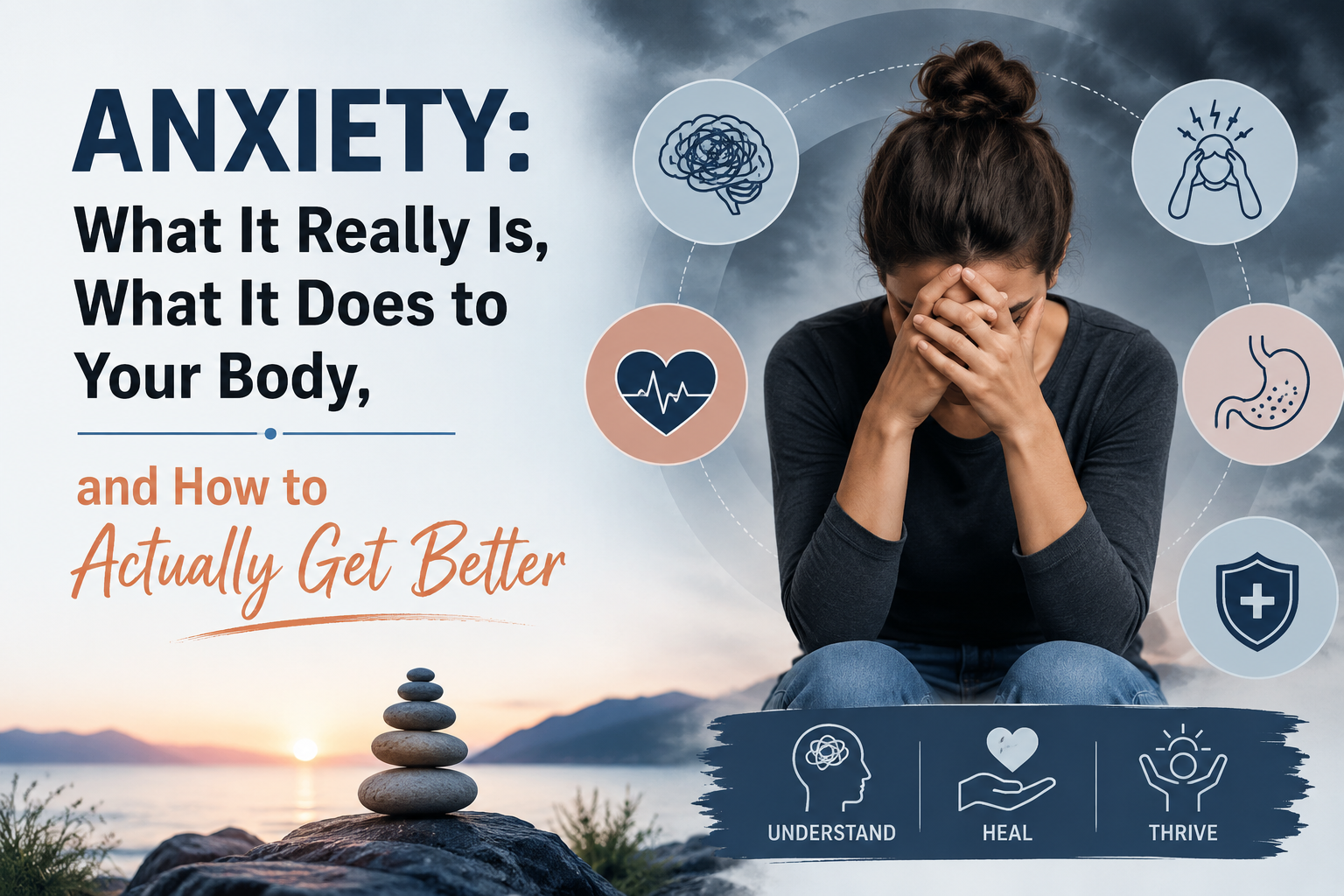
You know that feeling. The chest that tightens before a big meeting. The stomach that drops when your phone rings and you don’t recognise the number. The 2am mind that won’t stop running through every possible thing that could go wrong tomorrow.
That is anxiety. And if you feel it regularly, or if it has started to take over more of your life than you would like to admit, you are not alone. Not even slightly.
Right now, approximately 359 million people around the world are living with an anxiety disorder, according to the World Health Organization. That is not a typo. It is the most common mental health condition on the planet, more common than depression, more common than most physical diseases most people worry about. And yet most people who have it spend years either not knowing what is happening to them, or knowing but not finding anything that genuinely helps.
This article is for all of you. Whether you are a teenager who cannot stop spiralling before exams, a man who has been quietly drowning in worry for years but never named it, a woman who holds everything together during the day and then falls apart at night, or a senior who has noticed that what once felt like normal worry now feels uncontrollable. Anxiety looks different at every stage of life. But it is all real, and it all deserves real answers.
What Anxiety Actually Is
Most people think of anxiety as simply being “a worrier.” As if it is just a personality trait, something you either have or you don’t, something you can logic your way out of if you just try a bit harder.
That is not what anxiety is.
Anxiety is a biological alarm system. A deeply intelligent, deeply ancient piece of brain architecture that evolved to keep human beings alive in dangerous environments. When your ancestors heard a rustle in the bushes, their bodies immediately flooded with adrenaline and cortisol. Heart rate went up. Muscles tensed. Breathing quickened. The digestive system shut down to redirect blood to the limbs. Every unnecessary process was paused so the body could focus entirely on one thing: survive.
That system is called the fight-or-flight response, and it is still sitting inside your brain right now, largely unchanged from those thousands of years ago. The problem is that today’s “bushes” are emails from your boss, financial stress, relationship conflict, social media, and the relentless noise of modern life. Your nervous system cannot tell the difference between a physical threat and a psychological one. Both trigger the same alarm.
Dr. Martin Antony, Professor of Psychology at Toronto Metropolitan University and one of the world’s leading anxiety researchers, puts it this way: “Anxiety is not the enemy. It becomes a problem when the alarm goes off too often, too intensely, or in situations where the threat is not actually proportionate to the response.”
This is the defining feature of an anxiety disorder: the response is out of proportion to the situation, and it has become persistent enough to interfere with daily life.
The Brain on Anxiety: What Science Has Found
Understanding what is happening inside your brain when anxiety takes hold is genuinely helpful. Not in a textbook way, but because when you understand the machinery, the experience becomes less terrifying and far more manageable.
At the centre of it all is a small, almond-shaped structure in the brain called the amygdala. The amygdala is your brain’s threat-detector. It scans your environment constantly, and when it picks up something it classifies as dangerous, it fires an alarm to the rest of the brain and body within milliseconds. Faster than conscious thought.
In people with anxiety disorders, research has consistently shown that the amygdala is overactive. It fires more readily, to weaker threats, and it takes longer to calm back down. A 2024 study published in the journal iScience, led by neuroscientist Juan Lerma at the Institute for Neurosciences in Spain, found that overactive neurons in the amygdala not only drive anxiety but also social withdrawal and depression-like behaviour. The groundbreaking finding was that restoring balance to the amygdala’s neuronal activity actually reversed these behaviours in mice, opening the door to far more targeted treatments in the future.
Working alongside the amygdala is the prefrontal cortex, the part of your brain responsible for rational thinking, perspective-taking, and emotional regulation. In healthy anxiety responses, the prefrontal cortex acts as a brake. It steps in after the initial alarm and says, “Wait, let’s think about this. Is this actually dangerous?” In anxiety disorders, this brake is often weakened. The rational brain struggles to override the emotional alarm.
There is also the HPA axis (the hypothalamic-pituitary-adrenal axis), the hormonal chain reaction that floods the body with cortisol under stress. Chronic anxiety keeps this system activated. Chronically elevated cortisol does real physical damage over time: it disrupts sleep, impairs memory, weakens the immune system, raises blood pressure, and can even shrink the hippocampus, the part of the brain involved in memory and learning.
A comprehensive review published in the International Journal of Molecular Sciences in June 2025, from researchers at King’s College London and other institutions, confirmed that the three pillars of anxiety’s biological machinery are the HPA axis, serotonergic signalling (the serotonin system), and GABA neurotransmission (GABA is the brain’s natural calming chemical). Understanding this matters because it explains why both therapy and medication can work through completely different pathways and why combining them is often more effective than either alone.
The Different Types of Anxiety
“Anxiety” is an umbrella term. Under it live several distinct disorders, and identifying which one you are dealing with changes how you approach it.
Generalised Anxiety Disorder (GAD) is what most people mean when they say “I have anxiety.” It is persistent, excessive worry that spreads across multiple areas of life: work, health, family, money, the future. The worry is hard to control. It is there most days, more days than not, for at least six months. GAD affects approximately 6.8 million American adults and is twice as common in women as in men.
Panic Disorder is defined by recurrent, unexpected panic attacks. A panic attack is a sudden surge of intense fear that peaks within minutes and produces overwhelming physical symptoms including a pounding heart, chest pain, shortness of breath, dizziness, tingling, and a terrifying sense that you are dying or going mad. After a panic attack, the fear of having another one often becomes its own anxiety. This anticipatory anxiety can lead people to avoid places, situations, or activities where they fear an attack might happen.
Social Anxiety Disorder goes far beyond being shy. It is an intense fear of social situations, specifically the fear of being judged, embarrassed, or humiliated by others. It affects around 15 million American adults and typically begins in the teenage years. People with social anxiety will often avoid parties, public speaking, eating in front of others, or even making phone calls. The distress is not about being around people per se — it is about being perceived and evaluated by them.
Separation Anxiety is not just a childhood disorder. Adults can and do experience intense distress at the prospect of being separated from people they are attached to. It shows up in overprotective parenting, difficulty sleeping alone, and extreme worry when a partner or family member is not reachable.
Specific Phobias are intense fears of particular objects or situations: flying, needles, dogs, heights, vomiting, choking. The fear is always disproportionate to the actual danger, always recognised by the person as excessive, and always leads to avoidance. Specific phobias are the most common anxiety disorder, affecting an estimated 8 to 12 percent of American adults.
Agoraphobia is the fear of situations where escape might be difficult or help unavailable if something goes wrong. This often develops as a complication of panic disorder. In severe cases, people stop leaving the house entirely.
Physical Symptoms: The Part Nobody Talks About Enough
There are many other symptoms along with the basic mental symptoms: worry, dread, restlessness. Anxiety is as much a physical experience as it is a mental one, and for many people, the physical symptoms are the first and most confusing sign that something is wrong.
Your body, remember, cannot tell the difference between a lion and a stressful thought. So when the alarm fires, the body responds physically, every single time.
Here is what that can look like:
In the chest and heart: Racing heartbeat, palpitations, chest tightness that can feel disturbingly similar to a heart attack. This is one of the most common reasons people end up in emergency rooms, convinced they are having a cardiac event, only to be told it is anxiety.
In the gut: Nausea, stomach cramps, diarrhoea, an urgent need to use the bathroom before stressful situations. The gut has its own nervous system, sometimes called the second brain. It is in constant communication with the anxiety centres of the brain, which is why stress and anxiety almost always show up in the digestive system.
In the muscles: Tension headaches, jaw clenching, a rigid and painful neck and shoulders, trembling or shakiness. Many people with chronic anxiety carry their stress in their bodies for years before they connect the dots.
In sleep: The racing thoughts that appear the moment you lie down, the inability to switch off, waking at 3am with a jolt of adrenaline and a mind full of problems. Anxiety and sleep deprivation feed each other in a brutal cycle: poor sleep increases anxiety, which makes sleep worse.
In breathing: The tendency to take shallow, fast breaths from the chest rather than deep, slow breaths from the diaphragm. This creates a subtle but constant state of hyperventilation that keeps the nervous system on alert.
In concentration: The inability to focus. The sense that your mind is always somewhere else, always running threat simulations, always monitoring for danger.
An article in Harvard Health, reviewed by Dr. Howard LeWine, Chief Medical Editor at Harvard Health Publishing, noted that doctors see physical anxiety symptoms constantly in patients who have never connected them to anxiety. Patients with genuine stomach pain, genuine headaches, genuine muscle tension, spending years on physical treatments for what is actually an anxiety disorder.
If you have been to the doctor repeatedly for unexplained physical symptoms and everything keeps coming back normal, anxiety is worth seriously considering.
Anxiety Across the Lifespan: How It Looks Different at Every Age
This is the other major gap in most anxiety content. Anxiety does not look the same in a 15-year-old, a 35-year-old man, and a 70-year-old widow. Understanding how it manifests at each life stage is the difference between recognising it early and missing it for years.
In Teenagers (13 to 19)
Teenage anxiety has exploded. Research published in PMC based on Global Burden of Disease 2021 data found that from 1990 to 2021, the global incidence of anxiety disorders among those aged 10 to 24 years increased by 52 percent, with the steepest increases happening after 2019.
In teenagers, anxiety rarely looks like textbook worry. It looks like:
- Suddenly refusing to go to school.
- Becoming aggressive or irritable for no apparent reason.
- Complaints of stomach aches or headaches every morning before school.
- Withdrawing from friends.
- Spending increasing hours alone in their room.
- Dropping grades without explanation.
- Obsessive checking of social media but also being distressed by it.
- Avoiding any situation that might involve embarrassment or judgment.
Teenagers are also less likely to say “I feel anxious.” They are more likely to say “I feel sick,” “I don’t want to go,” or nothing at all, and simply disappear from situations that trigger them.
The Anxiety and Depression Association of America reports that anxiety disorders affect 31.9 percent of adolescents between the ages of 13 and 18. Untreated teenage anxiety is directly linked to poorer academic performance, social isolation, and significantly higher rates of substance use.
If you are a teenager reading this, take note that your anxiety is not weakness. It is not a drama. It is not something to push through alone. The things that help you most are talking to someone you trust, understanding what is happening in your brain, and learning specific skills for managing the alarm system. And none of that is something to be ashamed of.
In Young Adults (20 to 35)
The early adult years bring a particular cocktail of anxiety triggers: new independence, career pressure, relationship uncertainty, financial stress, the constant social comparison of social media, and increasingly, the aftermath of pandemic disruption during formative years.
The 2026 State of Mental Health report found that among all age groups, young adults report some of the highest rates of anxiety and depression. And yet they are also among the least likely to seek treatment, often citing cost, time, stigma, or the belief that they should be able to handle it themselves.
In young adults, anxiety often presents as: Chronic procrastination (avoidance is anxiety’s most trusted partner). Perfectionism that feels motivating until it becomes paralysing. Overworking as a way to feel in control. Difficulty in relationships due to fear of abandonment or conflict avoidance. Scrolling endlessly on a phone without being able to stop, even though it consistently makes them feel worse.
In Men (All Ages)
Men’s anxiety is genuinely underresearched, underdiagnosed, and undertreated. And the consequences of that gap are severe: men are significantly more likely to turn to alcohol, substance use, and risk-taking behaviour as coping mechanisms, and they account for approximately three-quarters of all suicides globally.
Research by doctoral candidate Krista Fisher at the University of Melbourne, published one of the first systematic reviews specifically on anxiety in men. Her findings were striking. Men with anxiety disorders are more likely to experience the condition through its physical symptoms: body aches, tremors, loss of appetite, headaches. They are less likely to identify these symptoms as anxiety, and more likely to feel guilt, shame, and powerlessness when they do.
The cultural expectation of stoicism, self-reliance, and emotional toughness means that millions of men are living with untreated anxiety that they have learned to disguise as anger, humour, busyness, or silence.
If you are a man reading this, whatever you have been taught about strength, asking for help when something is genuinely affecting your life is not weakness. It is the most practical thing you can do. Anxiety is a physiological condition. It does not respond to willpower any more than a broken leg does.
In Women
Women are statistically 1.6 times more likely to develop an anxiety disorder than men, according to research in the Journal of Psychiatric Research. Hormonal fluctuations across the menstrual cycle, pregnancy, postpartum periods, and menopause all interact with anxiety pathways in the brain in significant ways.
Women are also more likely to internalise anxiety, meaning they are more likely to ruminate, catastrophise, and blame themselves, rather than externalise it as anger or risk-taking. This internalising pattern can make anxiety in women very invisible to everyone around them, even as it exhausts them from the inside.
Women with anxiety are also more likely to carry anxiety about others: the children, the relationship, the parents, the household. Worry that feels selfless but is actually a symptom.
In Seniors (55 and Beyond)
Anxiety in older adults is dramatically underrecognised. Estimates suggest up to 15 percent of community-dwelling older adults have clinically significant anxiety. And yet it is often dismissed as “normal worrying about health,” “a natural part of ageing,” or misattributed entirely to medical conditions.
In seniors, anxiety presents uniquely:
Fear of falling becomes so intense it leads to avoidance of all movement, which then causes muscle weakness, which then increases the actual risk of falling. A feedback loop with devastating consequences. Health anxiety that becomes consuming after a diagnosis, major surgery, or the loss of a peer. Anxiety after bereavement that goes beyond normal grief: the profound uncertainty of a life rebuilt alone, financial anxiety, loss of identity and social role, fear of becoming a burden. Sleep anxiety: fear of not sleeping, which then guarantees poor sleep, which then increases anxiety.
A landmark longitudinal study published in PMC, the Health, Aging and Body Composition Study, followed nearly 3,000 adults aged 70 to 79 and found that those with anxiety symptoms showed significantly greater physical functional decline over five years compared to those without.
Anxiety in older adults is not just a quality-of-life issue. It has direct physical consequences.
If you are reading this, please note that you are not being dramatic. Your worry is not just “getting older.” Anxiety is very treatable at any age. You deserve the same quality of care and the same quality of life as anyone else.
What Actually Works: Evidence-Based Treatments
There is no shortage of anxiety advice on the internet. Most of it falls into two categories: so generic as to be useless (“drink chamomile tea and breathe deeply”), or so clinical as to feel inaccessible (“please consult your physician about pharmacological interventions”). This section tries to give you something more honest.
Cognitive Behavioural Therapy (CBT)
CBT is, by a significant margin, the most researched and most effective psychological treatment for anxiety disorders. Across dozens of randomised controlled trials and decades of clinical practice, it has consistently outperformed other therapies, and its effects are durable. People who complete CBT for anxiety typically maintain their gains years later, because they have learned skills, not just experienced symptom relief.
The core of CBT is the relationship between thoughts, feelings, and behaviours. Anxiety disorders involve characteristic patterns of thinking: catastrophising (assuming the worst), overestimating danger, underestimating your ability to cope, and avoidance. CBT teaches you to identify these patterns, test them against reality, and systematically face the situations you have been avoiding. The avoidance, it turns out, is what maintains anxiety over time. Every time you avoid something anxiety-provoking, you teach your brain that the avoidance was necessary. Facing it, gradually and deliberately, is how the alarm system learns to recalibrate.
<iframe width=”560″ height=”315″ src=”https://www.youtube.com/embed/9c_Bv_FBE-c?si=Gzd8rJARQZ_zon7e” title=”YouTube video player” frameborder=”0″ allow=”accelerometer; autoplay; clipboard-write; encrypted-media; gyroscope; picture-in-picture; web-share” referrerpolicy=”strict-origin-when-cross-origin” allowfullscreen></iframe>
Exposure Therapy
Exposure is often incorporated into CBT and involves deliberately and gradually facing feared situations or sensations. For specific phobias and panic disorder, it is extraordinarily effective. The biological basis: repeated, manageable exposure to feared stimuli teaches the amygdala, through a process called extinction learning, that the threat is not real. The alarm learns to stand down.
Acceptance and Commitment Therapy (ACT)
ACT takes a different approach from CBT. Rather than challenging anxious thoughts and trying to reduce anxiety, ACT teaches you to change your relationship with anxiety: to accept its presence, defuse from it (rather than being consumed by it), and commit to living by your values regardless of how anxious you feel. A 2019 systematic review in the Journal of Medical Internet Research found internet-delivered ACT to be effective for anxiety treatment, which is significant given how many people cannot access in-person therapy.
Medication
Medication is not for everyone, and it is not a first-line choice for mild or moderate anxiety. But for moderate to severe anxiety, the evidence supporting certain medications is strong.
SSRIs (selective serotonin reuptake inhibitors) and SNRIs (serotonin-norepinephrine reuptake inhibitors) are the first-line medication choices for anxiety disorders. They are not sedatives. They work gradually over several weeks by changing the sensitivity of serotonin receptors in the brain, which reduces the amygdala’s reactivity.
Always discuss medication options with a qualified psychiatrist or doctor, who can assess your specific situation, medical history, and the interaction with any other conditions.
What You Can Do Yourself, Right Now
Self-help strategies are not a substitute for treatment if you have a significant anxiety disorder. But they are genuinely useful in combination with professional support, and for milder anxiety, they can make a substantial difference.
Diaphragmatic breathing: When you breathe slowly from the abdomen, breathing in for four counts, holding for two, and out for six, you directly activate the parasympathetic nervous system, the biological opposite of fight-or-flight. This is not a metaphor. It is a physiological process. The extended exhale specifically activates the vagus nerve, which sends a calming signal to the heart and brain.
<iframe width=”560″ height=”315″ src=”https://www.youtube.com/embed/H6O0xX8jj1E?si=Ed4VJfJhsjDVQVpZ” title=”YouTube video player” frameborder=”0″ allow=”accelerometer; autoplay; clipboard-write; encrypted-media; gyroscope; picture-in-picture; web-share” referrerpolicy=”strict-origin-when-cross-origin” allowfullscreen></iframe>
Exercise: The evidence for exercise as an anxiety intervention is strong enough that many psychiatrists now consider it a clinical tool rather than a lifestyle suggestion. A meta-analysis of randomised controlled trials found that physical activity significantly reduces anxiety symptoms, including in older adults. Exercise burns cortisol, raises endorphins, improves sleep quality, and builds the kind of self-efficacy that anxiety tends to destroy. Even 20 to 30 minutes of moderate activity three to four times per week shows measurable effects.
Reducing stimulants: Caffeine directly stimulates the same physiological pathway that anxiety activates: the sympathetic nervous system. If you are anxious and consuming multiple coffees a day, you are biologically amplifying your anxiety. This is not about never drinking coffee again. It is about being honest about the relationship between your caffeine intake and your baseline anxiety level.
Sleep: The relationship between sleep and anxiety is bidirectional and brutal: anxiety disrupts sleep, and sleep deprivation worsens anxiety. Prioritising sleep is not soft advice. It is one of the most powerful things you can do for anxiety management. A consistent sleep schedule, limiting screens for 60 minutes before bed, a cool and dark room, and winding-down rituals are all supported by evidence.
Journalling: Writing about worry has been shown in multiple studies to reduce its intensity. When anxious thoughts stay inside the head, they can loop endlessly. When you write them down, you externalise them, and your brain’s threat-processing system can begin to evaluate them more rationally. Even ten minutes of free writing before bed can reduce nighttime anxiety significantly.
The 5-4-3-2-1 grounding technique: When anxiety is acute and you need something immediate, grounding exercises interrupt the spiral by forcing attention onto the present moment. Name five things you can see. Four things you can physically feel. Three things you can hear. Two things you can smell. One thing you can taste. This technique pulls the prefrontal cortex back online, which reduces the amygdala’s dominance.
When to Seek Help
There is a point at which anxiety stops being manageable with self-help and starts requiring professional support. Here is how to recognise that point:
- Your anxiety is affecting your ability to work, maintain relationships, or carry out daily activities.
- You are avoiding things you used to do, or situations that were not previously difficult.
- You are using alcohol, substances, or other behaviours to manage anxiety.
- You are having frequent panic attacks.
- You have physical symptoms that are not responding to medical treatment and that worsen with stress.
- Your anxiety has persisted for more than several weeks without improvement.
- You are having thoughts of harming yourself.
If any of these apply to you, please reach out to a doctor, psychiatrist, or psychologist. In most countries there are also crisis lines and online therapy options if access to traditional care is difficult.
This is not a sign of failure. It is a sign that your alarm system needs some professional recalibration. And that is entirely possible.
The Thing About Recovery
Anxiety does not usually disappear. And framing recovery as the elimination of anxiety entirely is one of the most counterproductive things anyone in the mental health space does, because it sets an impossible standard.
What recovery from an anxiety disorder actually looks like is this: the alarm fires less often. When it does fire, you can calm it more quickly. You stop avoiding the things you were avoiding. You stop organising your whole life around managing anxiety’s demands. You feel like yourself again, rather than like a person being managed by fear.
That is achievable. For the vast majority of people with anxiety disorders, effective treatment leads to significant improvement. The ADAA estimates that only 36.9 percent of people with anxiety disorders seek treatment, which means millions of people are living with something that is both genuinely treatable and genuinely limiting their lives, for no other reason than that nobody told them clearly enough that help works.
You now know. And if you are living with anxiety, you deserve to live without it running the show.
A Note on Stigma
One last thing. Anxiety is still stigmatised in ways that stop people from getting help. In cultures where mental strength is equated with emotional suppression, anxiety is seen as weakness. In busy, high-achieving environments, admitting to anxiety can feel like admitting to inadequacy.
None of that is true. Anxiety is a neurological condition with biological underpinnings. It affects some of the most accomplished, creative, and sensitive people in the world. The list of high-performing people who have openly discussed their anxiety disorders includes some of the most recognisable names in sport, business, art, and public life.
You are not broken. Your brain is doing exactly what it was designed to do. It just needs some help learning that the 21st century is not as dangerous as it thinks.
References and Research Sources
- World Health Organization. (2025). Anxiety Disorders: World Mental Health Today Report.
- Global Burden of Disease Collaborative Network. (2025). GBD 2023 Study, IHME.
- Fisher, K. et al. (2021). Anxiety in Young Males: A Systematic Review. Orygen, University of Melbourne.
- Lerma, J. et al. (2024). Neuronal Rebalancing in the Amygdala Reverses Anxiety Behaviours. iScience.
- Samara, N. et al. (2025). Molecular Basis of Anxiety: A Comprehensive Review 2014-2024. International Journal of Molecular Sciences, King’s College London.
- Frontiers in Neural Circuits. (2025). Research Progress on Neural Circuit Mechanisms of Anxiety.
- PMC / Global Burden of Disease 2021. Rising Global Burden of Anxiety in Adolescents 1990-2021.
- Anxiety and Depression Association of America. (2026). Facts and Statistics.
- LeWine, H. (2024). Recognising and Easing the Physical Symptoms of Anxiety. Harvard Health Publishing.
- Health ABC Study. Anxiety Symptoms and Decline in Physical Function Over 5 Years in Older Adults. PMC.
- Kelson, J. et al. (2019). Internet-Delivered ACT for Anxiety: Systematic Review. Journal of Medical Internet Research.
This article was reviewed by a licensed psychiatrist.
If you are in crisis or need immediate support, please contact a mental health helpline in your country. In India: iCall at 9152987821. In the US: SAMHSA National Helpline at 1-800-662-4357. In the UK: Mind Infoline at 0300 123 3393.
