


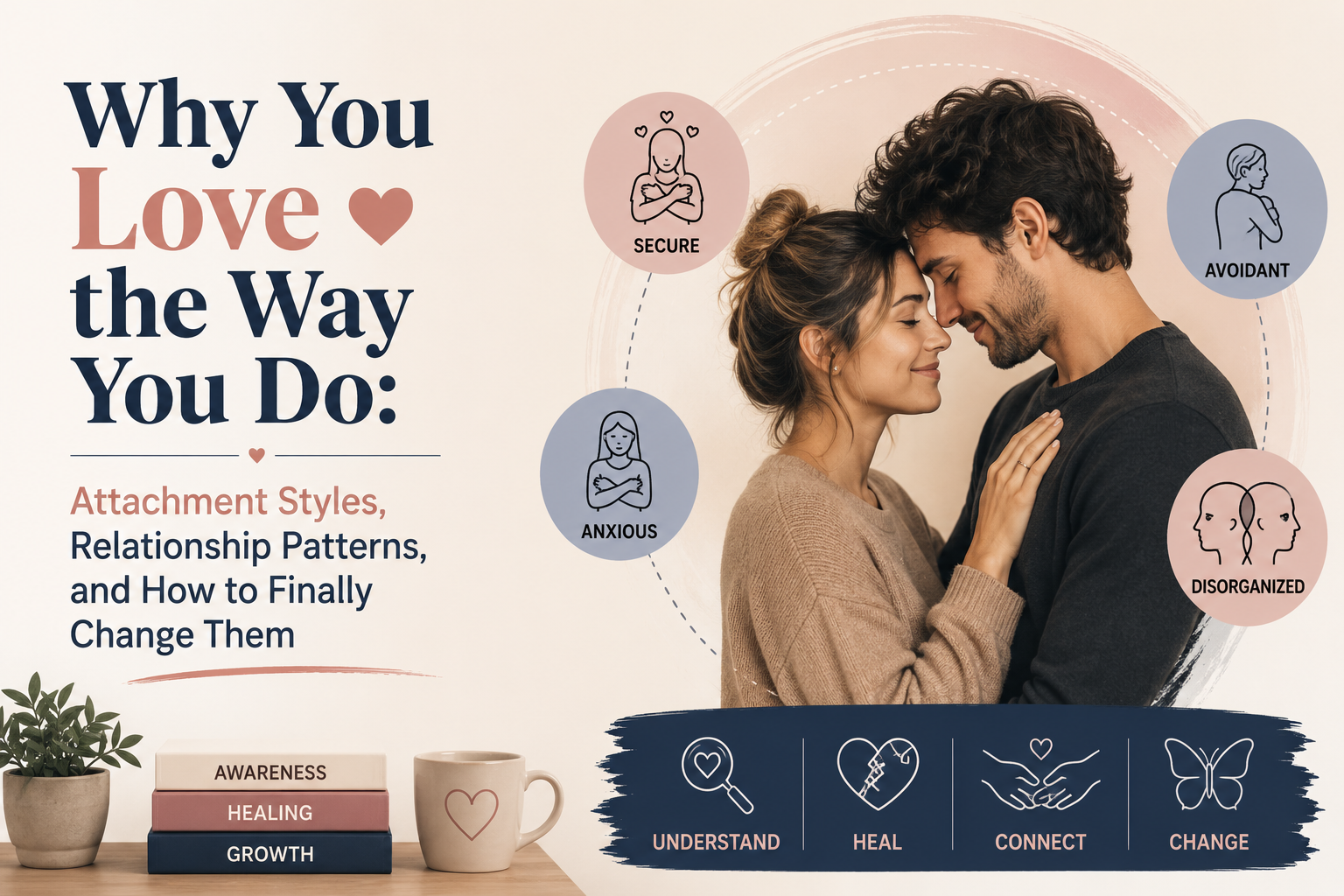
Have you ever found yourself in the same relationship, with a different person?
The details change. The face changes. But the dynamic, the way it starts with such intensity and ends in the same familiar kind of hurt, stays remarkably consistent. Or maybe you find yourself pushing people away the moment they get close, not because you want to, but because something in you simply does not know what to do with genuine intimacy. Or maybe you give and give and give in relationships, and somehow always end up feeling depleted and invisible, wondering how you got here again.
None of this is a coincidence. And none of it is a character flaw.
The way you love, the patterns you fall into, the things that make you feel safe or terrified in relationships, these were all shaped long before you went on your first date. They were shaped in the very first relationship you ever had, the one with the person who was supposed to take care of you when you were small, helpless, and completely dependent on their response to know whether the world was safe.
This is attachment theory. And understanding it may be the single most useful thing you ever do for your relationships.
Where It All Begins: John Bowlby and the Origins of Attachment Theory
In the 1950s and 1960s, British psychiatrist and psychoanalyst John Bowlby was working with children who had experienced early separation from their caregivers. What he observed changed psychology. He found that human beings are biologically wired to form strong emotional bonds with their primary caregivers, and that when those bonds are disrupted or unreliable, it creates lasting psychological consequences that reach far into adult life.
Bowlby called this the attachment system. It is not metaphorical. It is a real, neurobiological drive that activates from birth, orienting a child toward proximity with their caregiver as the primary strategy for managing fear, pain, and distress. When the caregiver is consistently responsive, the child’s nervous system learns: I am safe. People can be trusted. When I need comfort, it will come. When the caregiver is unpredictable, dismissive, frightening, or absent, the child’s nervous system learns a different lesson entirely.
In the 1970s and 1980s, developmental psychologist Mary Ainsworth built on Bowlby’s work through a series of now-famous experiments called the Strange Situation. She observed how infants responded when their caregiver briefly left the room and returned, and identified three distinct patterns: secure, anxious, and avoidant. A fourth pattern, disorganised, was later identified by researchers Mary Main and Judith Solomon.
What Bowlby, Ainsworth, and those who followed them established is that these early patterns, forged in the first two years of life, become what Bowlby called internal working models. Mental blueprints for how relationships work, how trustworthy other people are, and how worthy of love you are. And these blueprints operate largely outside conscious awareness, quietly influencing every relationship you form for the rest of your life.
A 2025 study published in Frontiers in Human Neuroscience confirmed that individual differences in attachment style are neurologically embedded, measurable even in EEG brain signals. The patterns laid down in childhood are not just psychological constructs. They are written, to some degree, into the structure and activity of the brain itself.
The Four Attachment Styles: Which One Are You?
Research by Bowlby, Ainsworth, and later expanded by psychologists Kim Bartholomew and Leonard Horowitz gives us four main attachment styles in adults. Understanding these is not about boxing yourself into a category forever. It is about gaining a map of patterns that, once seen, become possible to change.
Estimates from research published in Psychology Today suggest roughly 50 percent of the population has a secure attachment style, 20 percent are anxiously attached, 25 percent are avoidantly attached, and 5 percent have a fearful or disorganised attachment style.
Secure Attachment
If you grew up with a caregiver who was consistently warm, responsive, and available, who acknowledged your distress and comforted it rather than dismissing it or being overwhelmed by it, you likely developed a secure attachment style.
As an adult, this means: you generally trust that people are reliable and well-intentioned. You can ask for support without it feeling catastrophically vulnerable. You can tolerate disagreement and conflict without it feeling like the end of the relationship. You value your own independence and your partner’s independence without those things feeling like threats. When things are hard in a relationship, you lean into conversation rather than withdraw into silence or collapse into panic.
Secure attachment does not mean you had a perfect childhood or that you never struggle in relationships. It means you have a baseline sense that connection is safe, that you are fundamentally worthy of love, and that relationships can survive difficulty.
Anxious Attachment (Anxious-Preoccupied)
Anxious attachment develops when caregiving was inconsistent. Sometimes warm and responsive. Sometimes unavailable, distracted, or emotionally unpredictable. The child could not develop a reliable expectation of whether comfort would arrive, so they learned to turn up the volume on their distress signals to maximise the chance of getting a response.
In adult relationships, anxious attachment shows up as an intense longing for closeness combined with a chronic fear that it will be taken away. If this resonates with you, you may recognise some of these patterns:
You find yourself mentally rehearsing how a relationship could fall apart even when things are going well. A late reply to a message can send your nervous system into high alert. You seek a great deal of reassurance from partners, and even when you receive it, it only calms you temporarily before the anxiety returns. You can become preoccupied with a relationship to the point where it becomes difficult to focus on other areas of your life. Arguments feel catastrophic rather than manageable. Underneath everything, there is often a nagging belief that you are fundamentally too much, too needy, not quite enough, and that eventually the people you love most will leave.
Anxious attachment is not neediness as a character flaw. It is a nervous system that learned to treat uncertainty in close relationships as a genuine threat. And the way to change it is not to simply try harder to be less anxious. It is to give your nervous system sustained evidence that closeness can be safe.
Avoidant Attachment (Dismissive-Avoidant)
Avoidant attachment develops when caregivers were consistently emotionally unavailable, dismissive of the child’s emotional needs, or made the child feel that vulnerability was a burden or a weakness. The child learned that seeking closeness did not result in comfort. So they did the only logical thing: they stopped seeking it.
In adult relationships, this produces a deep preference for independence and self-sufficiency, combined with discomfort around emotional intimacy that can be deeply confusing even to the person experiencing it. You may genuinely want a close relationship and simultaneously feel an urge to pull away the moment one begins to deepen. You might describe yourself as “not good at feelings” or simply someone who values their space. Long-term commitment may feel like a threat to something important about who you are.
Partners of avoidantly attached people often describe feeling held at arm’s length no matter how hard they try to get close. That their partner seems to become more distant precisely in moments when the relationship is going well or when emotional closeness is being invited.
What avoidantly attached people often do not realise is that the suppression of attachment needs does not make them disappear. Research on the neuroscience of attachment shows that avoidant individuals show significant physiological arousal in response to intimacy and separation, even while their conscious self-report minimises distress. The feelings are there. They have just been driven underground by years of learning that expressing them was unsafe or futile.
Disorganised Attachment (Fearful-Avoidant)
Disorganised attachment, also called fearful-avoidant, is the most complex and the most painful of the four patterns. It develops in environments where the caregiver was both the source of comfort and the source of fear. This includes situations of abuse, severe neglect, or a caregiver who was themselves traumatised and therefore frightening or deeply unpredictable.
The result is an internal conflict with no resolution. The biological drive to seek closeness when distressed runs directly into a learnt belief that closeness means danger. The result is a pattern of simultaneously craving and fearing intimacy, oscillating between pursuing connection and fleeing from it in ways that can feel bewildering and out of control both to the person and to their partners.
If you have a disorganised attachment style, you may recognise the particular exhaustion of wanting nothing more than a close, loving relationship while also being the person who sabotages them. Of pushing people away when they get close and then grieving the distance. Of relationships that follow a pattern of intense early connection followed by chaos and withdrawal.
Disorganised attachment is closely linked to trauma histories, and healing it typically requires specific trauma-informed therapeutic support rather than general relationship advice.
Why Anxious and Avoidant People Keep Finding Each Other
There is a particular relationship dynamic that therapists see more than almost any other. A person with anxious attachment and a person with avoidant attachment find each other with what seems like magnetic inevitability, become intensely drawn together, and then spend the relationship in a push-pull cycle that exhausts them both without ever quite resolving.
The anxiously attached person pursues closeness, seeks reassurance, and interprets the avoidant partner’s withdrawal as evidence of their deepest fear: that they are unlovable and about to be abandoned. So they pursue harder.
The avoidantly attached person feels overwhelmed by what reads to them as neediness and demands for closeness. So they withdraw further. Which confirms the anxious person’s fears, which increases the pursuit, which increases the overwhelm, which increases the withdrawal.
Both people are doing exactly what their nervous systems were trained to do under perceived threat. Neither is the villain. But the dynamic feeds itself, and without awareness, it can go on for years.
Psychology Today attachment researcher Dr. Darlene Lancer has described this dynamic as having a push-pull quality driven not by incompatibility of character but by the way each style triggers the other’s core wound. Anxious attachment’s core wound is abandonment. Avoidant attachment’s core wound is engulfment, the loss of self in relationship. Each partner’s response to their own wound activates the other person’s wound in a perfect, painful loop.
Understanding this does not mean you should not be in a relationship with someone whose attachment style differs from yours. It means that without awareness and specific relational work, the dance will continue running on automatic.
Codependency: When Attachment Goes Further
Codependency is a term that gets used a great deal and understood a great deal less. At its core, it describes a relationship dynamic where one person’s sense of identity, worth, and emotional stability becomes so enmeshed with another person’s needs and wellbeing that they lose their own self in the process.
It typically develops in families where a child took on too much emotional responsibility too early. A parent with addiction, untreated mental illness, chronic illness, or their own unresolved trauma can create an environment where the child learns that love means caretaking, that their worth is determined by how well they manage other people’s emotions, and that their own needs are secondary at best and a burden at worst.
In adult relationships, codependency looks like: deriving your entire sense of self-worth from being needed by your partner. Having enormous difficulty saying no, even when saying yes costs you significantly. Feeling responsible for your partner’s emotional states and taking on guilt for their struggles. Staying in relationships that are harmful because the fear of abandonment is more overwhelming than the pain of staying. Consistently choosing people who need fixing or saving, and losing yourself in the effort.
Clearview Treatment’s clinical team notes that codependency is not love, even though it is consistently mistaken for it. It is an anxiety management strategy. The codependent person manages their fear of abandonment by making themselves so indispensable that leaving becomes impossible. And the person being enabled or caretaken often has their own avoidance of genuine intimacy reinforced, because the relationship dynamic protects them from ever having to show up in vulnerable, equitable terms.
Attachment Across the Lifespan: It Changes, and So Can You
In Teenagers (13 to 19)
Adolescence is the period when attachment begins to shift from parents to peers and romantic partners. This transition is a crucial developmental task. Teenagers with secure parental attachment tend to navigate it more successfully, maintaining their parental connection while gradually building autonomous identities and peer bonds.
For teenagers with insecure attachment, adolescence can amplify the distress significantly. Social rejection feels catastrophic because the nervous system is already primed to interpret relational uncertainty as a survival-level threat. First romantic relationships can activate attachment patterns with an intensity that adults looking on from the outside often underestimate.
If you are a teenager reading this and you find yourself either completely preoccupied with whether someone likes you, to the point where it disrupts your sleep, your focus, your friendships, or alternatively, you find yourself pushing people away even when you want closeness, both of these experiences make sense given what attachment theory tells us. They are not signs of immaturity. They are your nervous system responding to relationships based on what it has learned about whether closeness is safe. And they are patterns that absolutely can change.
In Young Adults (20 to 35)
Early adulthood is when attachment patterns typically get their most intense workout. First serious long-term relationships. Living with a partner. Navigating the question of commitment. Choosing whether and when to have children. All of these experiences activate the attachment system in its full adult form.
This is also, research shows, one of the most common periods for attachment patterns to begin shifting. Positive relationship experiences, therapy, and deep self-reflection can all produce meaningful movement toward security. A 2024 review in Social and Personality Psychology Compass, by attachment researcher William Chopik, confirmed that attachment orientations do change across the lifespan, and that new relationship experiences are among the most powerful drivers of that change.
In Adults (35 to 60)
Mid-adulthood brings its own attachment challenges. Long-term partnerships often develop their own dynamics, which can calcify unhealthy patterns if both people are not intentional about them. The pressures of parenting, career, and financial stress can create emotional distance in couples who were once close. Divorce is an attachment rupture of enormous magnitude, one that reactivates early attachment wounds with striking immediacy even in otherwise emotionally resilient adults.
This is also the period in which many adults begin noticing, often for the first time, that the relationship patterns in their marriage or long-term partnership mirror, uncomfortably, something from their family of origin. Therapy during this period, particularly approaches like Emotionally Focused Therapy (EFT) developed by Dr. Sue Johnson, which is explicitly built on attachment theory, can produce significant and lasting change in long-term relationship dynamics.
In Seniors (60 and Beyond)
Attachment does not stop mattering at retirement age. The desire for connection, for a felt sense of being valued and known by others, is a constant of human experience across the entire lifespan.
For older adults, attachment takes on particular significance in the context of bereavement. A 2024 systematic review published in the Journal of Social and Personal Relationships, examining loneliness across marital statuses with a specific focus on widowhood, found that widowhood was associated with a significantly greater likelihood of loneliness than any other marital status. Widowed individuals were lonelier, on average, than divorced, married, or never-married people.
Research published in PLOS ONE using an attachment framework for grief in older adults found that the intensity and nature of grief following spousal loss was significantly predicted by attachment style. Anxiously attached older adults showed greater emotional distress and difficulty accepting the loss. Avoidantly attached older adults showed less expressed emotion but were not protected from the psychological impact of the loss, it was simply less visible from the outside.
If you are a senior who has lost a spouse or a partner and the grief feels overwhelming and unending, that does not mean something is wrong with you. It means you formed a real, deep attachment bond, one that your nervous system does not simply release because the person is gone. Grief at this level is the direct cost of love at that depth. And it deserves proper support, not the assumption that you should simply have adjusted by now.
A 2025 research review published in Frontiers in Psychiatry on mental health in widowed older adults identified social isolation, lack of support, and the absence of meaningful connection as the key factors that transformed grief into long-term psychological harm. The single most protective factor, across study after study, was maintaining and building meaningful social connection.
If you are isolated, reaching out, whether to a grief support group, a therapist, a community organisation, or a trusted family member or friend, is not a sign of weakness. It is the most important thing you can do for your mental and physical health.
Can You Change Your Attachment Style?
This is the question that matters most to most people reading this. And the answer is yes. Not easily, not quickly, but genuinely and sustainably.
The concept that gives the most hope here is called earned secure attachment. It describes people who grew up in insecure environments but, through self-reflection, therapeutic work, or profoundly positive relationship experiences, developed what functions as a secure attachment in adulthood. Research published in 2025 in Personality and Social Psychology Bulletin, by Zumdahl, Saxsma, and Fraley, confirmed that adult attachment outcomes are not permanently determined by early adverse childhood experiences. The timing and nature of those experiences matters, but they do not write the final chapter.
What the research consistently shows produces change in attachment security:
Long-term therapy, particularly approaches that directly address attachment patterns. Emotionally Focused Therapy (EFT) for couples. Attachment-based individual therapy. Internal Family Systems (IFS). These approaches work not by teaching you facts about attachment but by providing a safe relational experience, the relationship with the therapist itself, that gradually updates your nervous system’s working model of whether closeness is safe.
A consistently responsive, trustworthy partner. Not a perfect partner. But one who shows up reliably in moments of distress, who repairs conflict rather than avoiding or escalating it, and who can tolerate your attachment needs without either collapsing into them or dismissing them. Over time, the accumulated experience of a reliable relationship literally rewires expectation.
Self-awareness and deliberate practice. Understanding your patterns, recognising them when they activate, and choosing a different response. This is hard, especially in the heat of a triggered moment, but it is genuinely possible. Journalling, mindfulness practices, and working with a therapist all support this process.
The key here is this: your attachment style is not your personality. It is a strategy your nervous system adopted to manage relationships in the environment you grew up in. When the environment changes, and when you do the work to update your nervous system’s expectations, the strategy can change too.
The Myth of Finding the Right Person
A huge amount of relationship advice is built on the premise that the right relationship will feel effortless, and that if a relationship is hard, that is evidence it is wrong. Attachment theory largely refutes this.
Healthy, secure relationships require work. They require two people who are both willing to look at their own patterns honestly, to communicate their needs clearly, to repair when things go wrong, and to tolerate the vulnerability of genuine closeness. These are skills. And like any skill, they can be learned.
A 2025 article in Psychology Today by a relationship and attachment scientist made a point worth sitting with: the labels anxious, avoidant, and secure that have flooded social media in recent years have a use, but they are significantly oversimplified. Real security in a relationship is not about finding someone with a secure attachment style. It is built together, through responsiveness, repair, and the accumulation of shared experiences that teach both people’s nervous systems that this, here, is safe.
The most powerful question you can ask in any relationship is not what attachment style does my partner have. It is: are we both willing to keep choosing each other, keep repairing, and keep showing up honestly? Because that, more than anything, is what secure attachment in adulthood is actually built from.
Professional Support
Attachment patterns that are deeply rooted, particularly disorganised attachment and patterns that stem from significant childhood trauma, are genuinely difficult to shift without professional support. This is not a failure of willpower or self-awareness. It is recognition that some wounds were created in relationship and need to be healed in relationship, specifically the safe, boundaried, consistent relationship that therapy provides.
If you recognise yourself in the descriptions of anxious, avoidant, or disorganised attachment and you feel the weight of these patterns in your relationships, please consider working with a therapist. You do not need to be in crisis to benefit. You just need to decide that the patterns you have been living inside are ones you are ready to start outgrowing.
<iframe width=”560″ height=”315″ src=”https://www.youtube.com/embed/gj_zo-8gTm4?si=6fTnPCtqCglAncpt” title=”YouTube video player” frameborder=”0″ allow=”accelerometer; autoplay; clipboard-write; encrypted-media; gyroscope; picture-in-picture; web-share” referrerpolicy=”strict-origin-when-cross-origin” allowfullscreen></iframe>
References and Research Sources
- Bowlby, J. (1969/1982). Attachment and Loss, Vol. 1: Attachment. Basic Books.
- Ainsworth, M. et al. (1978). Patterns of Attachment. Lawrence Erlbaum Associates.
- Chopik, W. (2024). Attachment Security and How to Get It. Social and Personality Psychology Compass.
- Zumdahl, M.G., Saxsma, M.G., & Fraley, R.C. (2025). Adult Attachment Outcomes and the Timing of Adverse Childhood Experiences. Personality and Social Psychology Bulletin.
- Frontiers in Human Neuroscience. (2025). Predicting Attachment Style from EEG Data.
- Vedder, A. et al. (2024). Exploring Loneliness Across Widowhood and Other Marital Statuses. Journal of Social and Personal Relationships.
- Kho, Y. et al. (2015). The Nature of Attachment Relationships and Grief Responses in Older Adults. PLOS ONE.
- Lin, D. et al. (2025). Research Trends and Hotspots in Mental Health of Widowed Older Adults. Frontiers in Psychiatry.
- Bartholomew, K. & Horowitz, L. (1991). Attachment Styles Among Young Adults. Journal of Personality and Social Psychology.
- NCBI. Neuroscience of Human Social Interactions and Adult Attachment Style.
- Psychology Today. (2025). Attachment Isn’t What You Think It Is.
This article was reviewed by a licensed psychiatrist.
If you are experiencing distress in your relationships or feel you may need support, please reach out to a qualified mental health professional. In India: iCall at 9152987821. In the US: Psychology Today’s therapist finder at psychologytoday.com/us/therapists. In the UK: BACP therapist directory at bacp.co.uk/search/Therapists.
